When scaling AI and machine learning workloads, the hardware you choose dictates your project's timeline and your bottom line. While the industry looks toward the newly rolling out NVIDIA Blackwell (B200/GB200) architectures and AMD MI300X accelerators, the reality for most scaling AI teams comes down to balancing availability, proven performance, and cost. Today, that means choosing between the NVIDIA A100 and the NVIDIA H100.
At Servers99, our engineers regularly deploy high-bandwidth GPU infrastructure for AI startups, research teams, and enterprise inference workloads. We often hear the same question: "Should we rely on the highly affordable A100, or invest in the dominant standard of the H100?"
In this technical breakdown, we will compare the A100 and H100 architectures, cite real-world performance benchmarks, and evaluate the Total Cost of Ownership (TCO). By the end, you will know exactly which hardware provides the best gpu dedicated servers for your specific AI model deployment.
High-Level Comparison: Ampere vs. Hopper
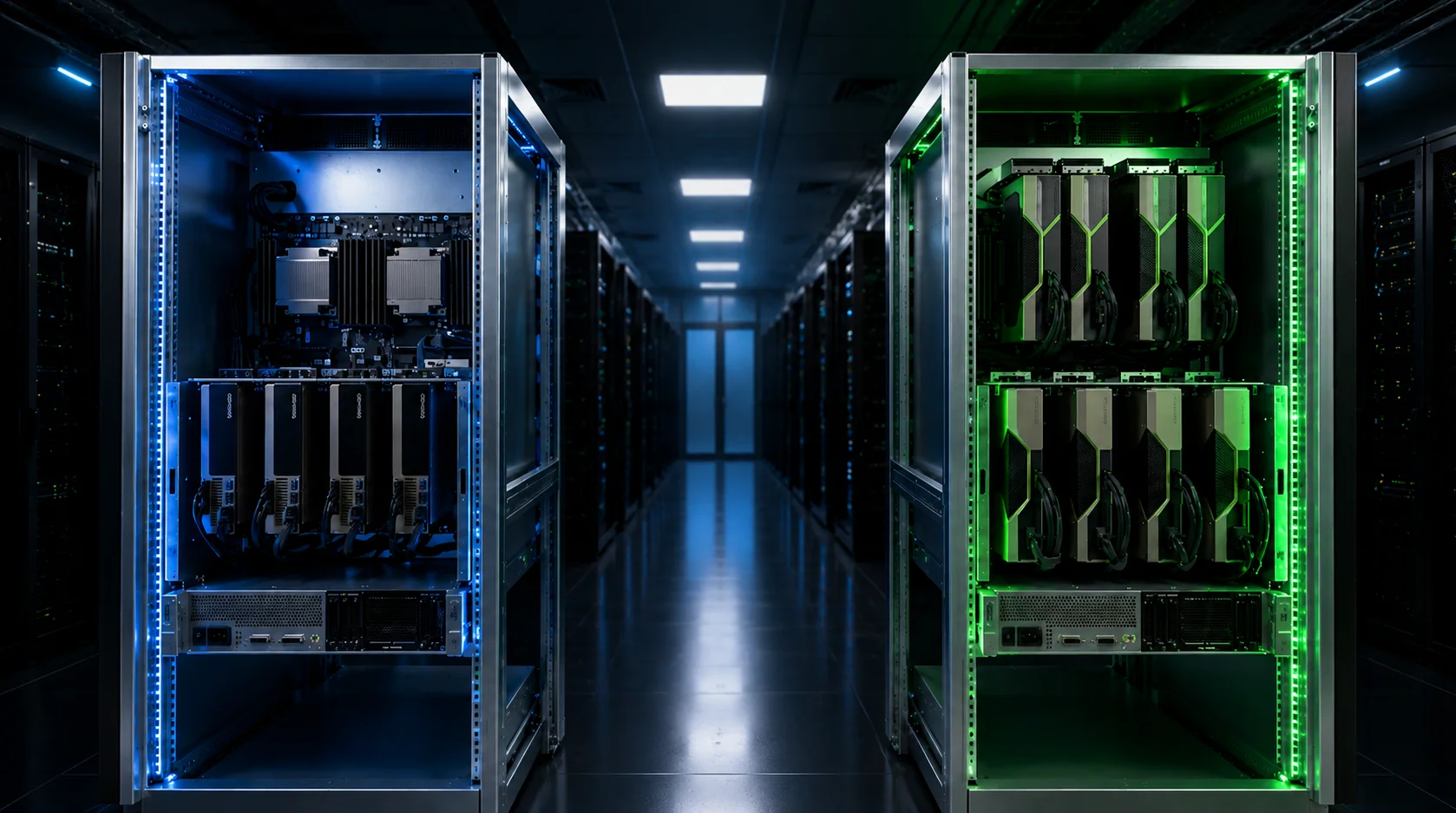
Before looking at specific use cases, let’s compare the raw specifications. Memory bandwidth and architecture are the most critical factors for AI model training and inference.
| Feature | NVIDIA A100 (Ampere) | NVIDIA H100 (Hopper) |
|---|---|---|
| Release Year | 2020 | 2022 |
| VRAM | 40 GB or 80 GB (HBM2e) | 80 GB (HBM3) |
| Memory Bandwidth | Up to 2.0 TB/s | Up to 3.35 TB/s |
| Precision Support | FP16, TF32, FP64 | FP8 (Transformer Engine), FP16, TF32, FP64 |
| Market Role | Budget/Legacy Workhorse | Current Data Center Standard |
| MIG Support | Yes (Up to 7 instances) | Yes (2nd Gen, Up to 7 instances) |
NVIDIA A100: The Reliable Enterprise Workhorse
Built on the Ampere architecture, the A100 was the undisputed king of AI. In 2026, it transitioned into a highly reliable, budget-friendly option for general AI, data analytics, and High-Performance Computing (HPC).
🔻 Best Suited For:
- Fine-tuning mid-sized models (7B to 70B parameters) using techniques like LoRA.
- Traditional machine learning, computer vision, and batch processing.
- Retrieval-Augmented Generation (RAG) pipelines.
🔻 Why Choose the A100?
The A100 features a massive, mature software ecosystem for all standard CUDA workloads. Because memory bandwidth has scaled more slowly than arithmetic bandwidth in recent years, the A100 is highly cost-effective for workloads that are memory-bound. Its Multi-Instance GPU (MIG) capability allows you to partition a single GPU into seven isolated instances, making these bare metal AI servers perfect for teams sharing hardware across multiple smaller R&D projects.
NVIDIA H100: The Dominant LLM Infrastructure
The H100 (Hopper architecture) is currently the standard-bearer for enterprise AI computing. It was engineered specifically to handle the massive Transformer models that dominate today's LLM landscape.
🔻 Best Suited For:
- Pre-training massive Large Language Models (70B+ parameters) across distributed clusters.
- High-traffic, real-time AI agents requiring low latency AI hosting.
- Workloads that can fully utilize FP8 (8-bit floating point) quantization.
🔻 Why Choose the H100?
The secret weapon of the H100 is its built-in Transformer Engine and advanced tensor core acceleration. By intelligently managing FP8 precision, it dramatically accelerates workflows without sacrificing model accuracy.
- Training: According to NVIDIA MLPerf benchmarks, the H100 can significantly outperform the A100 in transformer training workloads, offering massive throughput improvements when utilizing FP8 acceleration
- Inference: In many real-world inference workloads, the H100 can deliver roughly 2x the inference throughput of the A100 for large transformer models, making it the ideal AI inference server.
Inference vs. Training: Workload Matchup
Modern GPU demand is heavily leaning toward inference. Here is a quick guide on matching your specific workload to the right GPU:
| AI Workload | Best GPU Choice |
|---|---|
| Fine-tuning (LoRA/QLoRA) | A100 |
| Massive LLM Pretraining | H100 |
| Batch Inference | A100 |
| Large-scale Real-time Inference | H100 |
| RAG Pipelines | A100 |
| Real-time AI Agents | H100 |
The TCO Trap: Evaluating the True Cost of AI Infrastructure
When evaluating dedicated GPU infrastructure, focusing only on the monthly server price can be misleading. The real cost of AI infrastructure should be measured by training efficiency, deployment speed, operational overhead, and long-term scalability.
While NVIDIA H100 servers carry a higher monthly cost than A100-based infrastructure, they can dramatically reduce training and inference times for transformer-heavy workloads. For large-scale AI deployments, faster model iteration directly translates into lower engineering overhead and faster product deployment cycles.
For example, a workload that takes several weeks to complete on an A100 cluster may finish significantly faster on H100 infrastructure due to its higher memory bandwidth, FP8 acceleration, and improved tensor core performance.
In production AI environments, reducing training time is not just about speed — it also lowers operational complexity, minimizes infrastructure bottlenecks, and improves overall resource utilization. In many enterprise scenarios, this means the H100 can ultimately deliver a lower Total Cost of Ownership (TCO) despite its higher upfront infrastructure cost.
Where Blackwell and AMD MI300X Fit In
As we navigate 2026, it is impossible to ignore the broader hardware landscape. NVIDIA's Blackwell (B200/GB200) GPUs are beginning to emerge for ultra-high-end enterprise contracts, while the AMD MI300X is growing rapidly as a strong competitor for pure inference workloads due to its massive VRAM capacity.
However, for the vast majority of engineering teams today, the H100 remains the most accessible, perfectly balanced, and highly supported GPU for scaling AI into production, while the A100 remains the undisputed champion of budget-conscious fine-tuning.
Renting vs. Buying: Why Renting GPU Dedicated Servers is the Smarter Choice
When scaling operations, many teams debate whether to build an on-premise cluster or opt for enterprise GPU hosting. Here is why forward-thinking companies choose to rent:
🔻 Eliminating CapEx
Procuring a single 8x H100 server node requires a massive upfront investment. Renting shifts this to a predictable Operational Expenditure (OpEx), freeing up capital for hiring talent and acquiring data.
🔻 Avoiding Hardware Obsolescence
The AI hardware lifecycle is brutally fast. Renting transfers the risk of hardware depreciation to the hosting provider, allowing you to upgrade seamlessly.
🔻 Solving Power and Cooling
An NVIDIA H100 has a TDP of up to 700 watts. Standard server rooms cannot handle this thermal output. Renting ensures your hardware lives in Tier-4 data centers with industrial cooling and ultra-fast InfiniBand networking.
🔻 Instant Scalability
Avoid supply chain wait times. Providers offer instant provisioning so you can scale your high bandwidth GPU server cluster up or down immediately based on project needs.
Deploy High-Performance AI Infrastructure
Whether you need the proven, cost-effective reliability of the A100 or the unmatched speed of the H100, hardware procurement should not be your bottleneck.
For your demanding AI projects and high-performance GPU needs, Servers99 provides powerful, reliable GPU dedicated servers. Avoid the hidden fees of hyperscale cloud providers and get the raw compute power your engineering team deserves.